2 May,2026 By Fake Travel News
Castelmezzano is a beautiful small town in Italy. Why would a tic-tac-toe enthusiast want to go there? WHAT is a tic-tac-toe enthusiast? We want the story!
I first heard about Graham Holt through a retired Swiss diplomat who had encountered him in a Tallinn café, locked in a furious tic-tac-toe match against a nine-year-old girl. The girl won. Graham reportedly tipped her forty euros, called her “a formidable and ruthless tactician,” and immediately booked a flight to Basilicata, Italy — a region he had been circling on his personal map for what he described as “strategic reasons I am not yet prepared to disclose.”
Graham Holt is 58 years old, impeccably dressed in earth tones, and carries a burgundy leather journal in which he has documented every tic-tac-toe game he has played since 1991 — catalogued by country, opponent, outcome, and a brief psychological profile of the other party. The journal has 847 entries. He has never once opened the center square on his first move. He considers this a moral position.
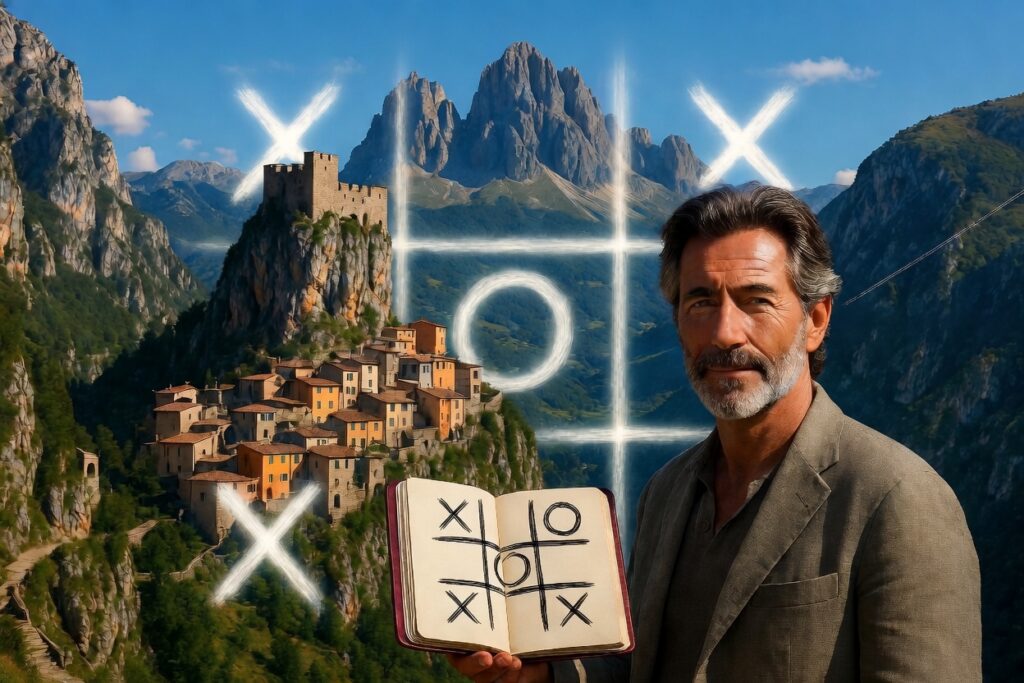
I caught up with him in Castelmezzano, a small town in Italy that is off the tourist maps but shouldn’t be.
Getting to Castelmezzano requires a two-hour drive from Naples, winding into the mountains of Basilicata until the road seems to simply give up — and then, suddenly, there it is: a medieval village stitched into the face of a rocky cliff like something a very confident civilization decided to build just to prove a point. The Dolomiti Lucane peaks rise behind it in jagged formation. It is, by any measure, a surreal and spectacular place, both during the day and at night.


Graham had arrived three days before me. I found him at a corner table at Trattoria Al Vecchio Scarpone, working through a plate of homemade pasta with sausage and sketching something in the margin of his journal. He waved me over without looking up.
“Sit down. I’ve made a discovery.”
He turned the journal to face me. It was a rough map of the surrounding valley, with Castelmezzano marked as the center square.
“You see,” he said, refilling my glass before I’d had a chance to drink from it — a habit, I would learn, of someone perpetually several moves ahead — “most people come here for the zip-line, the hiking, the views. Lovely. Fine. But they are missing the point.” He tapped the center square with his pen. “This town was built here deliberately. Defensive high ground. Control the center, control the board. The Normans who settled this cliff in the 11th century understood something that the rest of the medieval world was fumbling toward. They were, whether they knew it or not, tic-tac-toe strategists.”
The waiter refilled the antipasto plate. Graham thanked him warmly in flawless Italian and returned to his theory without missing a beat.
“Pietrapertosa,” he said, pointing to the neighboring mountain town visible across the valley, “is the upper-right corner. Every serious player knows the corner is the second most powerful position. Whoever controls Pietrapertosa in the 12th century controls the diagonal. It’s all right there in the historical record, if you know what you’re looking for.”
I asked what exactly he was looking for in Castelmezzano.
He smiled the way a man smiles when he’s been waiting for that question. “A game,” he said simply. “A worthy one.”
The next morning, Graham insisted we hike Le Sette Pietre — the trail of the seven stones connecting Castelmezzano to Pietrapertosa. It is a two-mile path that sounds manageable until you are 40 minutes in, vertical, and questioning your life choices. Graham wore a linen blazer. He was not winded.
The seven stones are manmade rock formations along the trail, each with a name and a theme: Delirium. Dancing. Flying. Cave of the Witches. Sorcery. Enchantment. Destiny. They are, in any reasonable interpretation, a meditation on the mystical and the human condition. Hikers typically pause at each one to reflect.


Graham paused at each one to assess its position relative to the others.
“Delirium — center-left. Dancing — top-center. You see the pattern?” He was sketching in the journal again, walking and writing simultaneously, which on a steep mountain trail is either impressive or reckless. “Seven stones. A three-by-three grid has nine positions. Two are missing.” He looked up with an expression of controlled urgency. “Two stones have been removed. Or perhaps never placed. Someone knew.”
“Knew what?” I asked.
“That completing the board would be too obvious.” He said this as if it were self-evident.
At the stone called Destiny — a brooding conical structure of stacked rock that loomed over the trail like something from a Tolkien novel — Graham stood in silence for a long moment. Around us, the Lucanian mountains rolled out in all directions, green and vast and indifferent to our presence. A hawk turned slow circles overhead. It was, despite everything, genuinely beautiful.

“Many of us are destined to be alone,” he read from the inscription, “while most of us sentence ourselves to it.” He closed the journal. “That’s about tic-tac-toe, you know.”
I did not know. I let it go.
Graham was staying at Casa del Mago — “once the home of a magician,” as it is advertised — a stone house with vaulted ceilings, a copper fireplace hood, and the kind of atmospheric interior that makes you feel you have stepped out of the 21st century without being entirely sure you want to go back. Hosts Pierfrancesco and Daniela run it with warmth and grace, the sort of people who make you feel like a houseguest rather than a customer.


They were also, by this point, deeply familiar with Graham.
“He rearranged the salt and pepper shakers this morning,” Daniela told me quietly over breakfast, gesturing toward the kitchen table where Graham sat absorbed in his journal. “Into a grid. He said it was for — how do you say — structural clarity.”
Graham had chosen Casa del Mago specifically and deliberately. “A magician,” he explained when I asked, “is simply someone who understands the hidden structure of things before everyone else does. The great tic-tac-toe players — and there are more than you think — are all, in their own way, magicians.” He paused. “I believe the original occupant of this house was working on a unified theory of diagonal strategy. I found some very suggestive scratch marks near the fireplace.”
Pierfrancesco, to his considerable credit, said only that he thought those were from a cat.
On his final morning in Castelmezzano, Graham boarded the Il Volo Dell’Angelo — the Flight of the Angels, a zip-line that carries you from the cliffs of Castelmezzano across the mountain gorge to Pietrapertosa, suspended over a valley of extraordinary and vertiginous beauty. Most people scream with joy. A few cry. Everyone arrives at the other end slightly changed.
Graham arrived at the other end with his journal already open.
I watched from the Castelmezzano platform as his figure grew smaller over the gorge, linen blazer flapping, one hand gripping the harness and the other — I’m almost certain — sketching something. Below him, the valley floor was a distant patchwork of green. The Dolomiti Lucane stood witness, as they have for a thousand years, to all manner of human behavior.
He found his game in Pietrapertosa. A retired schoolteacher named Enzo, 71 years old, who had a small table set up outside his door and who had, by all appearances, been waiting for something like Graham his entire life. They played seven games. Graham won four, lost two, and one ended in a draw that both men examined from multiple angles for twenty minutes before agreeing, with visible reluctance, that it was indeed a draw.
Graham recorded all seven in the journal. Enzo’s psychological profile, I later learned, read: Instinctive. Underestimates the center. Heart of a poet. Plays corners the way a man plants a garden — for future generations. Respect.
He took the hiking trail back to Castelmezzano rather than a second zip-line…said he wanted to visit the stones again. He had a new theory about which two were missing and why. The trail had some incredible views.


I drove Graham to Naples for his flight out. Somewhere on the winding mountain road, with Castelmezzano already invisible behind us, I asked him why tic-tac-toe. Of all the leisurely pursuits available to a man of his apparent intelligence and resources — chess, backgammon, snooker — why a children’s game?
He looked out the window for a long moment.
“Because everyone thinks they understand it,” he said finally. “And almost no one does. It looks simple, but it’s not simple. It is a game about controlling space before your opponent understands that space is the point.” He turned to look at me. “Also, it is the only game in which a nine-year-old in Tallinn can make me feel genuinely outclassed.” A pause. “She took the center on move one. I should have seen it coming.”
He was quiet the rest of the way to Naples.
The journal entry for Castelmezzano, I noticed when he set it on the dashboard, covered eleven pages. Next to the final entry, he had drawn a small tic-tac-toe grid. The center square was circled.
It was, of course, empty.
The non-fake disclaimer: Fake Travel News is a satire travel blog. We have fun creating and exaggerating travel stories from around the world, but we also love travel and the very real magic it grants to the human experience. For non-fake information on Castelmezzano, visit the following link: Castelmezzano and Pietrapertosa: What to Do, See, and Eat