30 Jun,2026 By Fake Travel News
I came to Gdansk because it was the cheapest flight out of a year that had stopped working. In one spring I’d lost a job I’d defended at three separate Thanksgivings and a man who left kindly, which is worse. I had some savings, no plan, and a surname on my passport that nobody in America had ever said right. Poland seemed as good a place as any to go be no one for a while. I picked Gdansk because it was on the water and I liked the look of the cranes.
The clerk turned my passport over. Kasia, he said — my first name, the real one, the one sanded down to Katie in the third grade and left that way. Brent had called me Katie for six years and never once wondered what was under it. Hearing the older name from a stranger, in a lobby that smelled like floor cleaner and old radiators, did something to the back of my throat I wasn’t ready to handle before coffee.
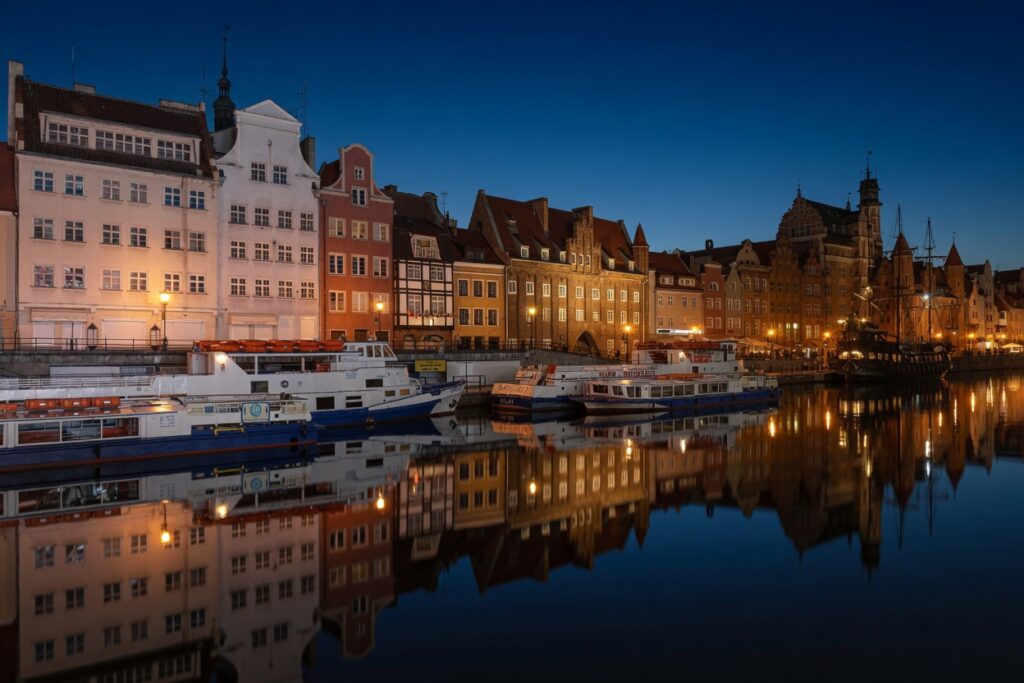
I went out walking that first night in Gdansk to avoid my own room. The amber shops were all shut, glowing faintly behind their grilles. The river smelled of diesel and salt. A gull stood on a bollard and watched me like it knew something.

The volleyball team arrived the next afternoon and the hostel stopped being quiet.
They were a club side from Naples, in Gdansk for a tournament nobody outside of volleyball had heard of. And they were loud — not rude-loud, just alive at a volume the Baltic doesn’t permit. Within an hour two of them had mummified themselves in spare duvets and stood at the window addressing the weather directly.
“This,” said Federica, gesturing at the entire grey country, “is attempted murder.” She was the star — you could tell because the others arranged themselves around her like punctuation. By day one she had declared war not on Polish food exactly but on the concept of it. “In Naples,” she informed the lobby, “even the air has flavor. Here the air tastes like a refrigerator.”
I told them my name was Katie. Chiara, the youngest, who spent every spare minute on the phone to a boyfriend in Salerno, heard it as Katia and called me that all week, which was somehow closer to the truth.
The coach was Lucia. Fifties, silver at the temples, the calm of a woman who’s watched twenty-two-year-olds make the same mistake for thirty years. When she found out I’d played at New Hampshire — it came up because I helped untangle a court the rec office had double-booked — she watched how I sorted it out more than she watched the volleyball. She looked at me the way you look at a tool you’d forgotten was in the drawer. I didn’t think anything of it. I should have.
The next morning the team went to practice and I went to the European Solidarity Centre alone.

It’s a rust-colored building, deliberately — weathered steel the shade of a hull left out in salt — standing where the shipyard is, where in 1980 the workers put down their tools and, impossibly, won. Inside it’s cool and echoing, all raw concrete, and it smelled faintly of school. I’d come, if I’m honest, to have a good private cry somewhere grand enough to make it feel like it counted. What I got instead was perspective, which is much less fun.

Near the end there are two sheets of plywood, the originals: the twenty-one demands, hand-painted in a hurry and nailed to the gate. The handwriting changes partway down — one careful hand giving out, another grabbing the brush to finish the list. Eighteen days they held that gate, against a government with tanks. I had held a four-year relationship and a job I was good at for exactly as long as each stayed easy.
After reading it twice I went and stood outside. I didn’t take a photograph. I just needed the cold Gdansk air.
That afternoon they made me climb the big church.
St. Mary’s is the largest brick church in the world, a fact you nod along to until you’re inside it and the nodding stops. Federica wanted the tower — four hundred and five steps, worn into shallow bowls by six centuries of feet. Here is what I learned about being thirty-one and formerly athletic among the currently professional: they went up like the stairs owed them money. I arrived a full flight behind, openly wheezing, and Chiara, not remotely out of breath, handed me her water bottle without comment.

It was on the way down, in a side chapel, that I found him: a stone Christ, seated, a crown of thorns above the bowed head, one hand pressed to the face. It was the exact posture I’d been hauling through airports and hostel bunks for three months. Sit with your head in your hand long enough and you start to think you invented the pose. Then I read the words cut into the floor: a memorial to the two thousand seven hundred and seventy-nine priests who died for this country between 1939 and 1945. The number has a terrible exactness to it.

Federica stopped beside me, unusually still. “My nonna had this exact face,” she said, quietly, almost to herself. “At my cousin’s wedding.” Then, recovering: “He looks how I feel about the food here.” I shouldn’t have laughed, in a church, in front of the dead. But I did, and it was the first time in three months a laugh came from somewhere real.
The team spent their free afternoon hunting for warmth in a city that does not sell it. First the AmberSky wheel out over the Motława, sixty meters of glass cabin that heats no one, where Gdansk spread out gold and grey beneath us and Federica refused to look down.

Then the beach, because someone swore the sea would be warmer. It was not.

There stood Ronald Reagan and Pope John Paul II, cast in bronze near the water, side by side, like two men who’d run into each other on a walk and got to talking about the fall of communism.

Federica photographed them for a long time. “Famous?” she asked. One used to run America, I said, and one used to run the Catholic Church. She nodded slowly, as if this confirmed something she’d long suspected about Poland. Lucia handed out chestnuts she swore were “almost” correct, warm through the paper. And somewhere between the wheel and the bronze, I stopped watching myself from across the room.
It was, of all things, the sushi.
There is one rule every traveler here learns, usually too late: never eat sushi in Poland. Federica had been in the country five days and learned nothing, on principle. She talked the team into an actual sushi restaurant — tablecloths, a laminated menu with photographs of everything — on the grounds that “sushi is not Polish, sushi is Japanese, it cannot be ruined.” I knew the rule. I ate the edamame, a great deal of rice, and said nothing. Oh, it could be ruined.
By morning Federica was the color of the Baltic, draped over a lobby chair, declaring herself in three languages to be “a cautionary tale.” We were a starting six minus one.
Lucia found me at breakfast. She didn’t so much ask as file a notice. “You play today. Right side. You remember right side?” She slid the scoresheet over for my name, and I don’t know what came over me — I wrote Kasia. First time in my life I’d handed that name to a stranger on purpose.
Then something lit up in my chest I’m embarrassed to report. This is the montage, I thought — the part where the washed-up protagonist finds herself again through the power of team sports. I genuinely thought there might be music. I knew it was deranged — I was a laid-off thirty-one-year-old in a borrowed jersey two sizes too big, not the third act of anyone’s comeback — and I thought it anyway, harder, the whole way to the gym.
The gym smelled of floor wax, and the Gdansk wind worked the high windows like it wanted in. My borrowed jersey kept slipping off one shoulder. The Naples girls had a chant, something fast and filthy about the opposing libero that they flatly refused to translate, and a crowd of maybe nine: somebody’s parents, two bored officials, a German tourist who’d come in for the bathroom and stayed.
My thighs had been on fire since the four hundred and five steps the day before, which is its own small report on who I used to be. I shanked a serve off the back of my own teammate’s head. I watched a block sail a clean foot wide of anything that mattered. My defense was, to use the technical term, decorative. The other team was simply better and had not eaten Polish sushi. It was over fast.
I stood there waiting for the tragedy to land. Instead I got the sound of eleven Italians zipping their coats. That was the part I wasn’t ready for — not the loss. The shrug. Those men down the road had held their gate for eighteen days; we’d held a court for about forty minutes, and were already onto the question of fried fish. Chiara was already scrolling her phone. Plastic chairs scraped. Federica, resurrected and outraged about being benched for it, was texting from the bench that she’d have won this blindfolded.

We ate at a long table by the water and they ordered like the loss was a rumor about other people. I’d spent most of that year eating standing up at a kitchen counter. So the plain fact of a long table did something to me before the food even came. Lucia put me in the middle, which I’d worked out by then was not an accident; when the wine arrived she filled my glass first, before any of her own players, and didn’t look up while she did it.
Federica, who had spent a week at war with this country’s food, ordered the cabbage thing twice and pushed the better plate at me without a word, which from her was a love letter. Someone told a joke in Italian and translated it for me badly, and I laughed at the bad translation. Lucia made me say grazie twice more until I stopped saying it like an American.
Tomorrow they’d fly back to Naples and I’d fly home to a life I’d have to rebuild from parts I didn’t have yet. The table would shrink to a group chat I’d be too shy to post in. I knew that, sitting in it.
Brent had called me Katie for six years and never wondered about the rest. Lucia had known me four days. Halfway through dinner she raised her glass down the table — Kasia, just to get the bread passed — and I turned, and answered to it, before I’d decided to do either.
Outside, the cranes stood lit against the dark, patient as ever over the black water. I came to Gdansk to be no one for a while. Turns out I’m bad at it.
The non-fake disclaimer: Fake Travel News is a satire travel blog. We have fun creating and exaggerating travel stories from around the world, but we also love travel and the very real magic it grants to the human experience. For non-fake information on Gdansk, visit the following link: Weekend Trip: The Best Things To Do In Gdansk