8 May,2026 By Fake Travel News
I greatly enjoyed this submission by Lieutenant Mariona Vila, Barcelona Resistance Division. Keep fighting, let’s make a new Independence Day!
People ask me how I ended up here. How a girl from East Los Angeles who saved fourteen months of coffee shop tips ended up as a lieutenant in a multinational resistance militia, running tactical operations out of a bunker beneath the Eixample district of Barcelona. I tell them the same thing every time.
I was trying to see the Sagrada Família.
My mother used to describe Barcelona the way some people describe heaven. Not as a place you go, but as a place that exists to remind you that the world, at its best, is worth the trouble. She left when she was nineteen, followed a man to California, had me, lost the man, and spent the next thirty years making ends meet in a city that had no idea what it had taken from her…she never went back. She died in March of 2025, car accident, and by October I had started putting sixty dollars a week into an envelope I kept under my bathroom sink. Here is the last picture of us together, after I placed second in a regional karate tournament.
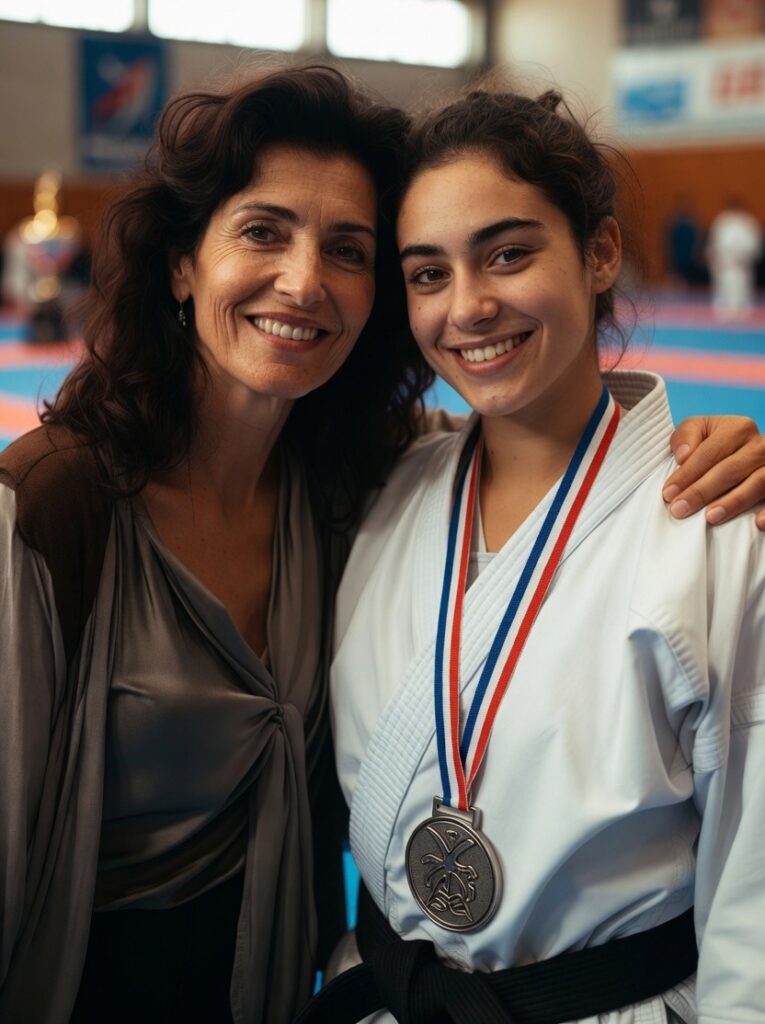
Fourteen months later, I landed at El Prat with a carry-on bag, a dog-eared copy of my mother’s old Barcelona guidebook, and the approximate Spanish of someone raised in a house where it was the only language that mattered.
I had nine days.
The ships appeared on the second morning.
I was eating a croissant de mantequilla at a café on the Passeig de Gràcia, my guidebook open to Casa Batlló, when the woman at the next table made a sound I had never heard a person make before. Not a scream exactly. More like the sound of someone’s understanding of the world simply stopping.
I looked up.
There were three of them visible from where I sat. Vast, dark, geometric — not the elegant saucers of movies but something more brutalist, more bureaucratic. Like enormous pieces of infrastructure that had simply appeared in the sky and expected you to accommodate them. They hung there with a kind of bored authority, the way government buildings do.

My phone lit up simultaneously with every alert it was capable of making.
The café emptied in four minutes. I finished my croissant.
Look, I know how that sounds. But I had fourteen months of tips invested in this trip and a guidebook with my mother’s handwriting in the margins. I wasn’t ready to panic yet.
The next three days were the strangest of my life, which is really saying something now.
Barcelona did not evacuate cleanly. The highways clogged within hours, and the Metro ran sporadically. The news cycled through denial, alarm, negotiation, and denial again in a loop that changed every few hours but never actually said anything. Meanwhile, the ships — everywhere in the world now — did nothing. They just hung there.
And I did what I had come to do.
I know it reads as absurd in hindsight, and I’ll admit that even at the time there was a quality to it that felt unhinged. But grief operates on its own logic. I had come to Barcelona for my mother, and some stubborn, daughter-shaped part of me refused to let the end of the world interrupt that.
I went to Park Güell on the first day of the occupation, as people were calling it. The famous tiled terrace was nearly empty, which meant I could stand exactly where I wanted and look out over the city, the dark shape of one of the ships hanging above the port like a bruise in the sky. Even with the alien ship looming overhead, Gaudí’s art refused to surrender: the entrance pavilion’s wild trencadís mosaics shimmered in bold blue-and-white patterns against the golden stone, while the Hypostyle Hall’s soaring ceiling blazed with radiant sunburst medallions of gold, emerald, and cobalt, every tile a defiant burst of joy.


I found a bench and read the passage my mother had written in the guidebook margin next to the Park Güell entry, in her small, certain handwriting: “Here I understood for the first time that beauty is an argument. For what, I’m not sure. But an argument.”
I sat with that for a long time.
I walked down to Casa Batlló that same afternoon. The facade was doing what it always does — that rippling, skeletal, almost living surface — and it struck me that Gaudí had spent his life building things that looked like they were breathing. Under a sky occupied by alien geometry, that felt newly relevant. Oddly, some of the imagery almost seemed like something you’d see on another planet.


The Barcelona Zoo was quieter than it had any right to be. I spent an hour there. One of the primates I encountered, a colorful mandrill, did not appear to be distressed. I envied him.

I took the cable car up to Montjuïc the following morning, which in retrospect was either very brave or very stupid given that one of the ships was hanging at roughly the same altitude several kilometers to the east. The castle at the top had been a fortress, a prison, a place of execution across its long history — it had seen worse occupations than this, arguably. I stood on the ramparts and looked out over the whole city and the harbor and thought: my mother stood somewhere on this hill once. I am certain of it.

That evening I found the dancing fountains still running. Nobody had thought to turn them off, or perhaps someone had decided not to. A small crowd had gathered — not tourists exactly, just people who needed somewhere to be. We stood and watched the water move through its colors in silence, the light show playing out against the dark, and for twenty minutes the ships were briefly forgotten.

I also spent a long, grateful hour at La Boqueria market, where several vendors were still open with the energy of people who intended to keep selling jamón and fresh fruit until told to stop. I bought olives and ate them standing up. Normalcy, rationed carefully, is a survival strategy.

I ate well beyond that too. The restaurants that stayed open were the good ones, staffed by people who had apparently decided that excellent food was load-bearing for civilization. I have never had a better pa amb tomàquet than the one I ate alone on the third night, watching two old men argue on a terrace across the street about whether the ships were American. They were not American. We were all fairly certain of that.
On the morning of the sixth day, the ships changed.
I don’t know how else to describe it. The quality of their presence shifted. They had been inert before — ominous but passive, like a threat that hadn’t yet decided to become a promise. That morning they became something else. A low frequency that wasn’t quite sound moved through the city. Dogs throughout the Gràcia neighborhood lost their minds simultaneously.
I was on my way to the Sagrada Família, as I had saved it for last, deliberately, the way you save the thing your mother talked about most. I had her guidebook entry for it nearly memorized. “There is no preparing yourself. Don’t try. Just arrive.”
I arrived.
The Nativity facade was as she had described it — overwhelming, biological, like something grown rather than built. Walking around Gaudi’s gem, I found myself wondering how a building raised to the glory of God was supposed to coexist with aliens.


Construction cranes that had flanked it for over a century were still there, though the workers were not. The plaza was nearly empty, the air thick with that subsonic wrongness, the sky behind the towers occupied by a ship that had repositioned overnight and now hung directly above the city center as if making a point.
I was standing in front of the central portal when the first one came around the corner of the building.
I had seen images by then — everyone had, grainy footage from São Paulo and Seoul and Nairobi. But images had not communicated the specific quality of wrongness that a live alien carries with it. The way every animal instinct you have fires at once, unanimously, and all of them say the same thing. I remember thinking with strange clarity: my mother never had to deal with this.
It was tall, maybe seven feet, with a geometry to its limbs that suggested they had more joints than limbs should have. It moved toward me with what I can only describe as administrative purpose. Not aggression exactly. More like I was something that needed to be processed.
I had been doing karate since I was young, strictly as a hobby, because I liked the discipline and the hitting of things. I was not a fighter in any serious sense. What I did for the next ninety seconds was not karate. It was more like a very determined argument conducted with my elbows and knees against something that did not understand it was in an argument.
I found that its joints, while strange, still bent in directions they apparently weren’t supposed to. It was surprised by resistance, which told me something about what it had encountered before me. One of my strikes cut it, and a drop of blood, or some bodily fluid, hit my arm and burned badly. I recoiled for a second, then kept fighting. I realized two things…that I was getting my ass kicked, and that I was not going to stop.
The shot came from my left.
The alien dropped. I staggered back against the facade of the Sagrada Família and breathed.
The soldier was young — mid-twenties maybe. He was staring at me with an expression I would come to know well, the particular look of a military person recalibrating a situation.
“Estàs bé?” he said. Are you okay.
He’d spoken Catalan, but I caught it. “Més o menys,” I said. More or less.
Something shifted in his face. He looked at me, then at the alien, then back at me. He asked me in Spanish where I had learned to move like that, and I told him East Los Angeles and a dojo in Silver Lake, and he laughed — a short, exhausted, genuine laugh.
His name was Corporal Dani Puig, Catalan, twenty-six, former competitive wrestler, current member of what was then a three-day-old informal resistance cell operating out of a parking garage off Carrer de Provença. He told me they needed people who didn’t freeze. He said he had watched me for forty seconds before he shot and that in those forty seconds I had done three things that should have been impossible given what I was fighting and what I knew about it, which was nothing.
I told him I had come to Barcelona on vacation.
He said that vacation was probably over.
I thought about my mother’s guidebook in my bag, the pa amb tomàquet, the dancing fountains, and the bench at Park Güell where beauty had made its argument. I thought about fourteen months of coffee shop tips in an envelope under a bathroom sink in East LA, and a woman who had left this city at nineteen and never found her way back.
My mother would think this was completely insane, but she would also understand exactly why I said yes.
That was four years ago. Corporal Puig is Captain Puig now, and my commanding officer, and the most stubborn human being I have ever met, which is the primary qualification for this work. The parking garage off Carrer de Provença is a bunker, and the three-person cell is a division.
The ships are still there.
But so are we.

I still have the guidebook. The cover is wrecked and there’s a dark stain on the Barceloneta chapter that I prefer not to identify. But my mother’s handwriting is intact throughout — her small annotations, her arguments with the text, her careful stars next to the things she loved most.
The Sagrada Família gets four stars. The highest she gave anything.
I think she would have liked how it looked that morning, even with a dead alien in the plaza and the sky doing what it was doing. Gaudí built it to be permanent. He built it to outlast everything.
He may have been right.
The non-fake disclaimer: Fake Travel News is a satire travel blog. We have fun creating and exaggerating travel stories from around the world, but we also love travel and the very real magic it grants to the human experience. For non-fake information on Barcelona, visit the following link: The Ultimate Barcelona Travel Guide 2026 (+ Map) – Kelsey in London